Macroevolutionary dynamics of Mesozoic hybodontiform fishes
- Grant DOI: 10.55776/PAT1454425
- Start: February 3, 2025
- End: February 2, 2029
Principal Investigator (PI)

Dr. Sebastian Stumpf
ORCID: 0000-0002-1945-2387
ResearchGate
Collaborators
- Univ.-Prof. Dr. J. Kriwet (University of Vienna, Austria)
- Univ.-Prof. Dr. Gilles Cuny (Claude Bernard University Lyon 1, France)
Wider research context/theoretical framework
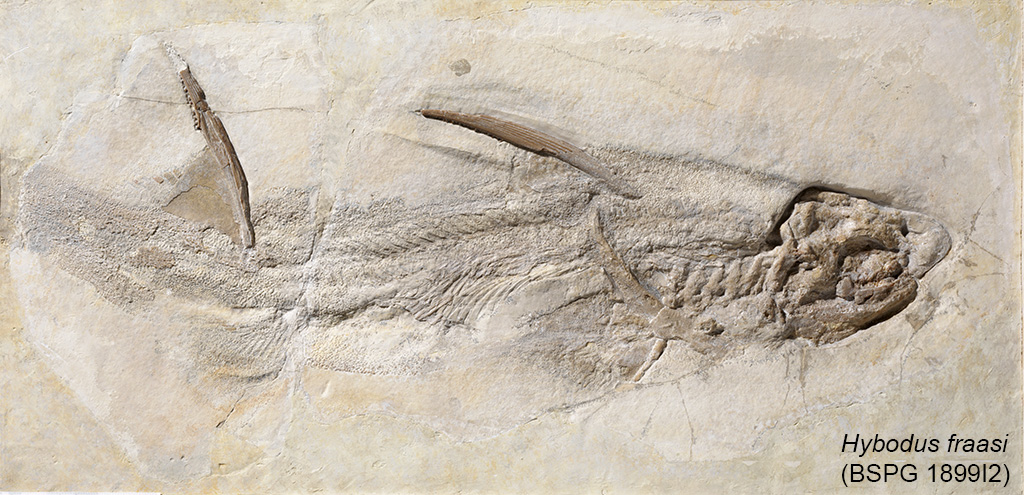
Hybodontiforms are one of the most iconic groups of extinct chondrichthyans, regarded as the putative sister group to modern sharks, rays, and their immediate fossil relatives. Hybodontiforms are characterized by shark-like bodies with two dorsal fins, each supported by prominent fin spines. Together with modern sharks and rays, they formed the most dominant chondrichthyan lineage during the Mesozoic, and in particular during the Jurassic hybodontiforms were in full swing, before declining and becoming extinct at the end of the Cretaceous. Mesozoic hybodontiforms have attracted research attention since the early days of vertebrate palaeontology. However, despite almost 200 years of extensive research, the hybodontiform tree of life is still a matter of debate and further questions need to be addressed by future work to provide a more holistic picture of Mesozoic chondrichthyan evolution.
Research questions
The main goal of this project is to establish a robust phylogenetic framework to address gaps in our knowledge of Mesozoic hybodontiform evolution and diversity. In particular, the study of Jurassic hybodontiforms from Europe, represented by abundant and well-preserved but still insufficiently studied material from some of the most important fossil sites in the world, is key to the projects success. These fossils offer an extraordinary opportunity to better understand the evolutionary history of chondrichthyans during the time when modern marine ecosystems began to take shape. The project will address the following questions: (1) What is the taxonomic composition of Jurassic hybodontiforms and what are the implications for understanding Mesozoic hybodontiform evolution and diversity in general? (2) Can the phylogenetic relationships among better-known Mesozoic hybodontiforms be reliably resolved? (3) Are hybodontiforms monophyletic, and if so, how do they relate to other chondrichthyans? (4) Was competition from modern sharks and rays a factor in the diversity decline of Mesozoic hybodontiforms?
Methods
This project will combine taxonomy, systematics, modern phylogenetic methods, and disparity and diversity analyses to answer these questions.
Level of originality/innovation
The results will have significant implications for understanding the macroevolutionary patterns and processes that shaped the evolution of Mesozoic hybodontiforms and chondrichthyans in general.